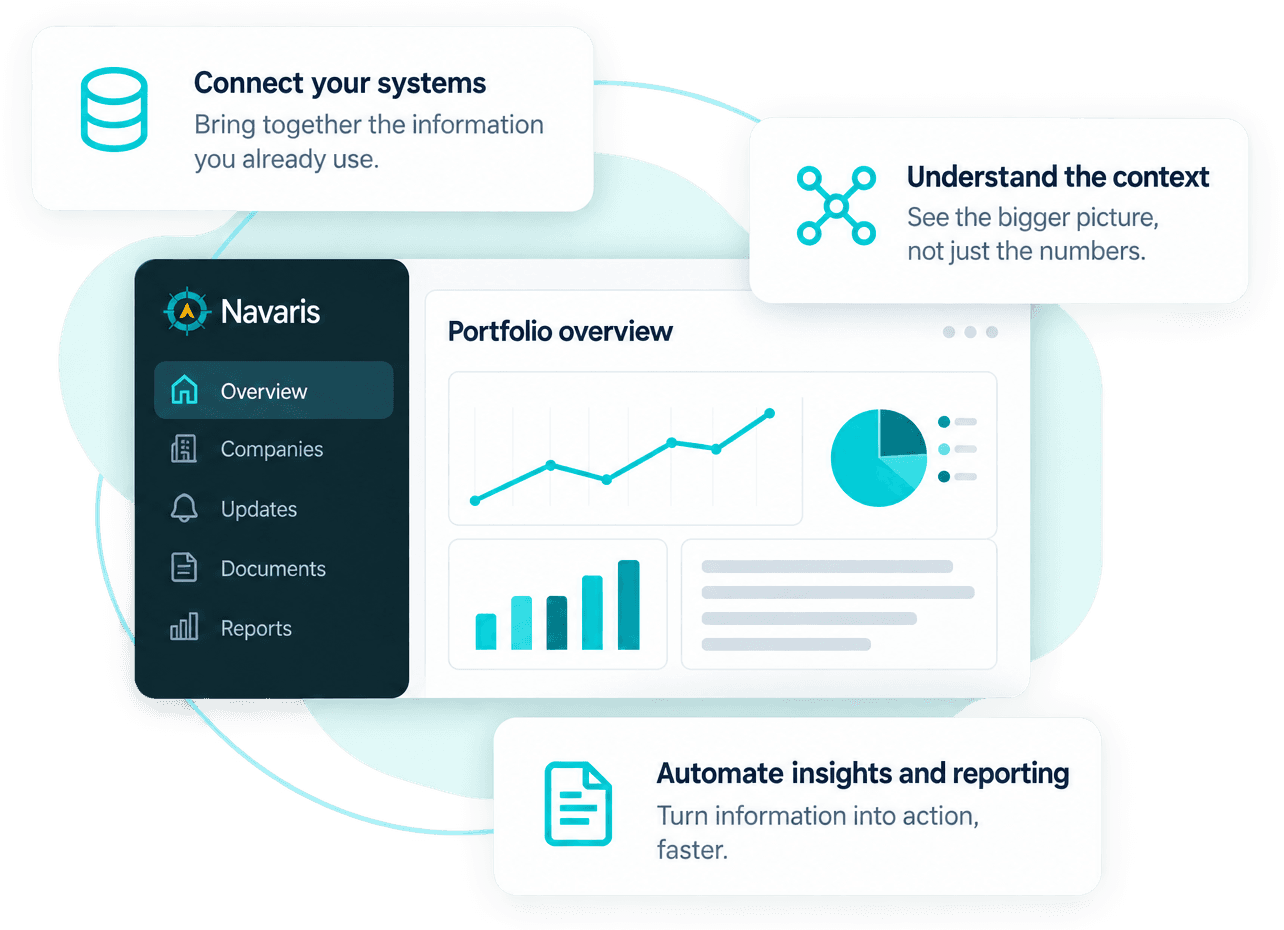

One live record of the business. The right version for every audience.

You hold a minority stake and no mandate to demand a reporting pack - so silence becomes the same thing as no news.

  • Runway calculated from cash and trailing burn in their own accounts, not a form
  • Reserve earmarks re-run whenever a runway or round date moves
  • IPEV marks, ILPA templates and EIS status built from the same data your portfolio view reads

Fund II

14 companies

Runway read from banking and trailing burn, not a quarterly form

Halcyon Bio

Series A · burn £184k/mo

4.1 mo

Reforge Labs

Seed · burn £61k/mo

7.8 mo

Northbeam

Series A · burn £122k/mo

11.2 mo

Cadence Health

Seed · burn £44k/mo

16.5 mo

Sorted by runway · two companies inside reserve trigger

Stop reconstructing what the business already knows

Everything an investor, a board, a lender or a funder wants to know already exists - spread across the ledger, the bank, the billing system, the CRM and a folder of documents. What costs weeks is pulling it together, shaping it for each audience, and doing it again next month.

What matters next

Priorities ranked across eight areas of the business, updated as the underlying numbers move.

Risks surfaced early

A key customer set to cancel, a covenant tightening, a runway threshold crossed - flagged when the clock starts, not at the next review.

Progress against the plan

Scored on whether the numbers actually moved, not on whether an initiative was marked complete.

Ask in plain English

Questions over one business or a whole portfolio, answered from the record with the source attached.

Stay ready for every audience

The right story, evidence and reporting ready for investors, boards, lenders, programmes and customers - shaped from the same record rather than assembled again from scratch each time someone asks.

  • Every figure derived one way, so the board pack and the investor update cannot disagree
  • Current between the updates, not only at the point one is written
  • Nothing to fill in, because it is built from systems rather than from recollection

One record, five audiences

Investors

Traction, plan progress and use of funds

The board

Performance against budget, risks and decisions

Lenders

Covenant headroom and cash, with the calculations

Programmes and funders

Impact, eligibility and match funding

Customers

Security posture, stability and certifications

One record, built from the systems you already run

Nobody fills it in. Navaris reads the systems the business already runs and keeps a single record current, so the workspace it works from and the reporting it produces are drawn from the same source rather than assembled by hand.

1

The company connects its systems

Ledger, banking, billing, CRM, HR, delivery and Companies House. Read-only, approved by them, and nothing rekeyed.

2

Agents build the record

Specialist agents read each system, derive every metric the same way, extract key terms from documents, and capture each business event with the system it came from.

3

One record, every output

The business works from it directly. Everything it then shares - board packs, investor updates, lender packs - is drawn from that same record, so nothing is rebuilt and the company controls what each audience sees.

This is why the record stays current. Reporting that has to be filled in by hand decays, because keeping it up to date is a chore with no reward. Here the same record that produces the reporting a business owes also produces what it chooses to share with the people around it - so nobody maintains a second system, and two documents drawn from it cannot quietly disagree.

Know a number will hold up when someone checks it

Every business event names the system it came from and how it was derived. That is the difference between a dashboard that is pleasant to look at and evidence that survives contact with an investor, a lender or an auditor.

  • Material events surfaced in days rather than at the next review
  • Connections found across systems that no single tool would show
  • One version of events, so the board pack and the update cannot diverge

A risk surfaced

Top-20 customer set to cancel - £41k ARR

StripeMaterial event

Derived from: cancel_at_period_end set on the subscription

Flagged the same day, with the renewal owner notified before the renewal date rather than after it.

A priority changed

Runway fell below ten months

Open banking + ledger

Derived from: Cash over trailing three-month net burn

The workspace reordered itself. Raise preparation moved above the hiring plan for the following week.

A board pack updated

October management accounts locked

Xero

Derived from: Period lock date set on the accounting period

The board pack redrafted from the locked figures. Nobody rebuilt the deck by hand.

A filing kept current

Confirmation statement due at Companies House

Companies House

Derived from: Filing date read from the public register

Flagged three weeks ahead and pre-filled from the company record, rather than found the week it was due.

The company decides what Navaris sees, and what leaves the building

Connecting a business system is a serious thing to ask, and the answer has to be convincing before a founder or a CFO will do it. Access is read-only, scoped and revocable, and nothing reaches an investor that the company has not agreed to share.

Read our security overview

Read-only

Never moves money or changes a record.

Approval-first

Nothing indexed until it is approved.

Granular permissions

Down to the area and the document.

Full audit trail

Every access, share and export logged.

Frequently Asked Questions

Agents connect to the systems a business already runs - ledger, banking, billing, CRM, HR, delivery and Companies House - and build one live record of that company.

The business works from that record: what matters next across eight areas, the commitments it owes, and its board packs, investor updates and management accounts drafted from live numbers. Navaris keeps a live view current for the investors, board and lenders the business shares it with - so its leaders spend far less time assembling updates and answering the same questions.

It updates straight from the connected systems as the business runs - there is no portal for anyone to fill in. Because the company already uses Navaris for its own work, the live view its investors, board and lenders see stays current as a by-product of that work.

That is what removes the reporting scramble: the picture is always up to date, so the business's leaders are no longer the bottleneck between a question being asked and it being answered.

Accounting and banking, billing and subscriptions, CRM, HR and applicant tracking, delivery and monitoring, compliance platforms, cap table software, document storage and Companies House. Xero, open banking, Stripe, HubSpot, HiBob, Jira, GitHub, PagerDuty, Vanta, Ledgy and Google Drive among them, with more added regularly.

Every connection is read-only. Navaris reads to keep the record current; it never moves money, sends anything on your behalf, or changes a record in a company's systems.

Every figure carries its source, and every event on a company's timeline names the system it came from and how it was derived - a subscription set to cancel, a period lock date, a filing at Companies House.

System-derived facts carry their source. Management judgement is clearly identified as such. That is what makes it usable in diligence rather than only in a board meeting.

Businesses that need to stay ready for the people they answer to - from a start-up before incorporation to an established company with a board and a bank - and the investors, boards, lenders and programmes who need a current picture of how those businesses are doing.

For the business, it means far less time lost to updates and diligence. For the people backing it, it means a live view rather than waiting on the next report. What each audience gets is different, and the detail lives on the solutions pages.

On the company side: board packs, investor updates, management accounts, lender information packs and statutory filings. On the other side, from what the company shares: the valuation, LP and regulatory reporting the people backing a business need.

All of it reads from the same record, so a figure cannot differ between two documents sent in the same week. The specific frameworks each audience needs are listed on the relevant solutions page.

The company does. Access is approval-first: nothing enters the record until it is approved, and nothing reaches anyone outside the company that the company has not agreed to share.

Permissions are granular down to the area and the individual document, they can be revoked at any time, and every access, share and export is logged.

Have more questions?

Contact Us

See it on a real business

Bring one reporting deadline or one real question about the business to a walkthrough, and we will work through it in the product.